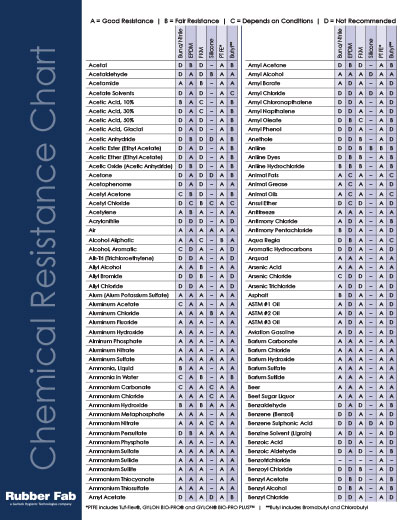
Chemical Resistance Chart
Chemical resistance plays a key role when selecting an elastomer
Use this chemical resistance chart to identify which elastomers stand up to specific chemicals, acids, solvents, fuels, and steam across common industrial applications. Download it for quick reference. Our Chemical Resistance List offers a concise overview of favorable and unfavorable material compatibility pairings and links to detailed chemical compatibility resources for deeper guidance. The chemical resistance chart is paired with a broader chemical compatibility chart and a material compatibility chart for chemicals so you can confirm gasket material choices before installation.
Good and poor material compatibility pairings for specific chemicals
The chart helps you quickly spot favorable pairings—such as PTFE with strong acids, FKM with many hydrocarbons, and EPDM with water, steam, brake fluids, and certain ketones—and it flags mismatches that risk failure. For example, the EPDM chemical resistance profile is generally strong against polar substances (like alcohols and glycols) but weak with aromatic and aliphatic hydrocarbons and most oils. Conversely, Buna (NBR) is often suitable for oils and fuels but performs poorly with strong oxidizers. These pairings are summarized to help you avoid premature gasket degradation and unplanned downtime, and they are reinforced in our chemical compatibility chart and material compatibility chart for chemicals for cross-verification.
Because performance depends on concentration, temperature, pressure, and exposure time, always cross-check chart entries against your specific operating conditions. Materials that rate “good” in general charts can still fail if the chemical is hotter, more concentrated, or part of a mixed stream. Use the chemical resistance chart alongside the broader chemical compatibility chart for a layered view of suitability under typical use cases, and consult FKM chemical compatibility and FKM chemical compatibility data when fuels, oils, or aggressive hydrocarbons are present.
Why expert advice matters when selecting gasket materials
Charts are essential starting points, but real-world variables often fall outside generic ratings. Batch variability, dynamic cycling, mechanical stresses, permeation, and regulatory requirements (FDA, USP, 3-A) all influence performance beyond what a chart alone can convey. Consulting with our applications specialists helps validate assumptions, interpret ambiguous ratings, and tailor recommendations to your service conditions—especially for complex media blends or CIP/SIP regimes, or when detailed FKM chemical compatibility and chemical compatibility information is needed for mixed hydrocarbon service.
For instance, the EPDM chemical resistance rating may shift with frequent steam cycles or the presence of trace solvents. Our team can confirm whether EPDM remains appropriate or whether alternatives such as PTFE-encapsulated elastomers, FKM, or silicone offer a better safety margin. This guidance reduces risk, improves seal life, and supports compliance across gaskets, O-rings, and sanitary seals.
Where to find charts and selection tools
• Gasket material compatibility chart: Access our downloadable gasket material compatibility chart and full chemical compatibility chart at the bottom of this page. This resource consolidates data for common elastomers and thermoplastics, letting you compare options quickly. You will find the chemical resistance chart in an easy-to-scan format, with links to detailed notes and conditions. For multiple reference points, the chart is also mirrored in our Knowledge Center with the comprehensive chemical compatibility chart and the material compatibility chart for chemicals for cross-verification.
• Chemical resistance guide for hoses: Visit here to find a chemical resistance guide for hoses. The guide references the hose names and applications that are compatible for that hose.
• Gasket selection guide: Visit our Gasket Selection Guide to move from compatibility screening to product choice. The guide integrates compatibility ratings with application criteria such as temperature range, pressure class, surface finish, regulatory compliance, and installation practices. Where the chart suggests multiple viable materials, the guide helps narrow the field by performance and certification needs.
How to use the charts effectively
1) Identify your media: List each chemical (including cleaners), with concentration and temperature, plus exposure to steam, fuels, or solvents.
2) Consult the chemical resistance chart for each chemical to flag “Good Resistance”, “Fair Resistance”, “Depends on Conditions”, or “Not Recommended” materials for gaskets and seals.
3) Cross-check in the broader chemical compatibility chart to confirm trends, noting edge temperatures and mixed-media effects; for fuels and oils, review FKM chemical compatibility and chemical compatibility entries.
4) Review the material compatibility chart for chemicals to compare elastomer families side by side and to locate a gasket material compatibility chart for quick screening.
5) Validate choices with our experts, particularly when EPDM chemical resistance or other elastomer ratings are marginal at your conditions or when steam cycling is frequent.
Key takeaways and how to access
• The chemical resistance chart outlines compatibility details of gasket materials with industrial fluids, chemicals, acids, solvents, fuels, and steam.
• Confirm findings in the chemical compatibility chart and the material compatibility chart for chemicals to account for variations in conditions and mixtures.
• Use dedicated FKM chemical compatibility data for hydrocarbon-rich services and fuel exposure.
• EPDM performs well with many aqueous and polar media but poorly with oils and hydrocarbons; verify against your temperatures and concentrations.
• Find and download the gasket material compatibility chart and the chemical resistance guide for hoses and gaskets on our website under Resources.
Download the latest chemical resistance chart directly from our Chemical Resistance List page, review the chemical compatibility chart for deeper context, and consult the material compatibility chart for chemicals to compare elastomer families. If you have questions about EPDM chemical resistance, FKM chemical compatibility —or need help interpreting results—contact our technical team for personalized support and a tailored gasket selection recommendation.
 Sanitary Gaskets
 Detectomer® Family of Products
 O-Rings
 Sanitary Hose & Hose Assemblies
 Hose Fittings & Adapters
 Tubing
 Sight Gauges
 Sanitary Clamps
 Sanitary End Caps
 Compression Control Products
 Pump Replacement Parts
 Carton Filler Replacement Parts
 Sanitary Tube Supports
 Data Center Cooling
 Food Processing Products
 Cheese Processing and the Dairy Industry
 Sanitary Seals & Hoses for the Beverage Industry
 Pet Food Processing Industry
 Craft Beverage Industry Solutions: Gaskets and Hoses
 Cannabis Extraction Equipment
 Pharmaceutical Validation Products
 Getting the Perfect Crimp on a Hose Fitting
 Coding & Labeling Services
 Product & Technical Services
 Packaging & Drop Shipping Services
 Quality Assurance Certification & More
 Literature
 Part Number Library
 Technical Articles/Documents
 Informational Videos and Training
 Product E-Catalogs
 Case Studies – Product Innovations at Work
 Frequently Asked Questions
 Rubber Fab eNewsletter Archive